Understanding the Legacy Meter Replacement Program (LMRP) for Strata Committees and Managers
Thank you for taking the time to review this information. Our goal is to educate strata committees, tenants and strata managers about what is happening, how it will impact your building, and what your options are regarding the Legacy Meter Replacement Program (LMRP) currently being rolled out across Australia. We are a team of highly competent Level 2 ASP electricians who have worked on the meter replacement program since its inception in 2016. We specialize in multi-occupancy meter installations and replacements in both new and existing developments. With our experience and refined processes, we can complete these jobs safely and efficiently, having worked alongside electricity retailers and metering coordinators for nearly a decade.

What is the LMRP?
The Legacy Meter Replacement Program (LMRP) is part of Australia’s national accelerated rollout to replace all older “legacy” electricity meters, including annual or basic non-smart Type 5/6 meters, with modern smart meters (Type 4) across the National Electricity Market. This market covers New South Wales, Queensland, South Australia, Victoria, Tasmania, and the Australian Capital Territory.
The LMRP is driven by rules set by the Australian Energy Market Commission (AEMC) under the Accelerating Smart Meter Deployment reforms. Electricity distributors develop Legacy Meter Replacement Plans, which must be approved by the Australian Energy Regulator (AER). These plans schedule the replacements, typically in phases from late 2025 through to November 30, 2030. Your electricity retailer is responsible for arranging the actual installations through metering coordinators and their contractors.
Participation is mandatory for customers; opting out is not permitted. The rollout is required by changes to the National Electricity Rules, with the aim of achieving full smart meter coverage by the end of 2030. The main reasons for this initiative include:
- Enabling a more efficient, flexible, and renewable-energy-ready electricity system.
- Providing better real-time data for usage monitoring, faster fault detection, and improved network management.
- Supporting consumer benefits such as time-of-use tariffs, easier retailer switching, and integration of solar and batteries.
- Reducing long-term costs by improving grid operations and eliminating manual meter readings.
Program Costs and Payment Responsibilities
When researching the program, you will often encounter statements such as “No Upfront Costs for the meter replacements” from regulatory bodies and electricity retailers. This can cause some confusion, while this is true in most cases for sites which are compliant with current standards, the reality is that the costs associated with the electricity network, including metering, are built into our electricity bills through tariffs and connection fees. For sites that are compliant with current standards, there will be no upfront charges for meter replacement. However, if additional work is needed—particularly on sites with shared fusing—a new individual Meter Protection Device (MPD) must be installed for each unit. These costs can vary and are recoverable by the electricity retailer.
Protections are in place to prohibit retailers from profiting from meter replacements, but they are allowed to recover the total costs incurred by them, which include network isolations, meter hardware, and installation costs incurred by Metering Providers.
Challenges with Meter Replacements
Since 2018, a major barrier to replacing meters has been the large number of sites with shared fusing, especially in New South Wales. Strict legislative rules prohibit power from being interrupted for any unit other than the one with a work order. To address this, stakeholders developed the “One In All In” process over 18 months, and even if your meter has already been replaced you will still experience a power outage while the rest are replaced. However, based on our extensive experience, we believe this solution is likely to fail for several reasons:
- It is overly complicated due to the number of parties involved. – You can change this!
- No single party is incentivised to take control and coordinate the site. – Tekwave can fix this.
- It requires multiple technicians from competing companies to collaborate. – You can change this.
- Communication is fragmented across multiple retailers and goes directly to tenants, with no requirement to inform strata managers or committees of outage dates and times. – Tekwave can fix this.
- Different metering providers use different systems, causing confusion during joint efforts. – Tekwave can fix this.
- The financial impact on technicians was not considered; some technicians will have more jobs than others but need to be onsite for the same duration. – You can Change this.
- Meter technicians are paid per meter replaced, not per hour. If a technician does not have enough jobs to make the day financially viable, they may not show up, resulting in additional outages at a later date. – Tekwave can fix this
- Having more people onsite slows the process, leading to longer power outages. Limited workspace means technicians spend more time waiting than working. Power outages of up to 8 hours per 10 meters on a panel are allowed, but the duration varies by site configuration and may require multiple outage days. – Tekwave can fix this.
Recent Legislative Changes and Their Potential Impact
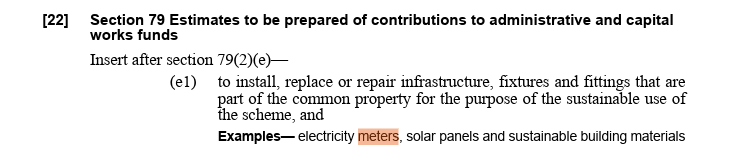
Recent changes to the Strata Act suggest that if the current process fails, new solutions are possible as foundations have been laid in updated strata laws to keep the 2030 target on track. Specifically under section 79 of Strata Schemes Management Act 2015 No 50, amendments have recently granted additional powers to Fair Trading, strengthening enforcement of defect rectification and requiring sites to be brought up to current standards, even if they were compliant at the time of construction.
Sites with shared fusing are now identified and labelled as defects when preventing meter replacements. Currently, retailers and their nominated metering coordinators are assuming responsibility for installing MPDs during replacements as part of the LMRP, with the cost recovered later from their customer base. However, there is no rule in the National Electricity Rules (NER) or National Electricity Retailer Rules (NERR) requiring them to do so. If the “One in All In” process is deemed unworkable, responsibility for MPD installations could be passed on to Owners Corporations, requiring them to arrange installations before meters can be replaced. Guidance on potential costs can be found on many strata websites, and these costs can be significant, especially for larger sites, possibly requiring a special levy if not budgeted for.
Our Solution and Its Benefits
This is where our team comes in. We offer alternative pathways to achieve the same goal—replacing all legacy meters—more efficiently, saving money, and minimizing power outages from potential days to just a few hours. All it requires from you is to get in touch with us, and we can distribute our eform to you remotely via your property manager or comittee. Its a basic form, all thats needed is name, address, retailer and NMI which is all located on your electricity bill. Its that simple we do the rest.
How Do We Accomplish This?
By engaging us as the sole contractor for meter replacements and any required rectification work, we can achieve significant efficiencies by reducing unnecessary coordination under the current plan. These efficiency gains allow us to properly scope and plan the replacement schedule to fit a more realistic timeline, reducing disruption to tenants affected by outages. Additionally, the increased efficiency enables us to provide and install the MPD free of charge as part of our process. *If we do not charge retailers for MPD installations, they cannot recover the costs from you.

While we can’t stop the mandatory replacement of legacy meters, we can work together to streamline the process and minimise the headaches and costs for everyone involved. Simply reach out to us, and we’ll take care of the rest!

What's In It For Us You Ask?

As outlined, our compensation comes from retailers via their metering coordinators who we are partnered with for each meter replacement. Even when replacements occur through the “One in All In” process, it is likely that we will be present for those replacements. We are keen to offer our process because it is significantly more efficient, enabling us to pass savings onto you while we benefit from enhanced efficiency as well. In our view, this approach is safer, quicker, and yields better outcomes for everyone, all while substantially lowering overall program costs. Like you, we are consumers of electricity and understand the challenges posed by rising costs.
While we cannot provide precise figures on how much the meter replacement program contributes to rising costs, we are confident that our more efficient process can help mitigate these expenses. We believe that, when implemented on a larger scale, our approach will help reduce or slow down price increases for everyone. All it takes is for individuals like you to be informed and to actively participate in being part of the solution.
Even if your building doesn’t have shared fusing issues, you can still benefit from this process, its actually even more straight forward for you! Reach out for further information.
What are the next steps if we would like to take advantage of this better option?
It’s simple, Email us at admin@tekwave.com.au and we can provide you with an info pack and simplified comparison sheet of the two Processes to discuss with other tenants and committee members. There will be no costs charged to you by Tekwave, so you don’t need to approve funding or have budgeted for it, we actually remove the need to do that. It’s a simple choice of whether you would like to take advantage by being proactive, reduce disruptions to your building and save on costs that you would eventually incur when the “One in All In” process gets scheduled for your building in the near future.